
Island Explorer
I built Island Explorer, a browser-based game with an infinite procedural world. The interesting part is that all the pixel art assets were generated using PixelLab, an AI tool for creating game-ready pixel art.
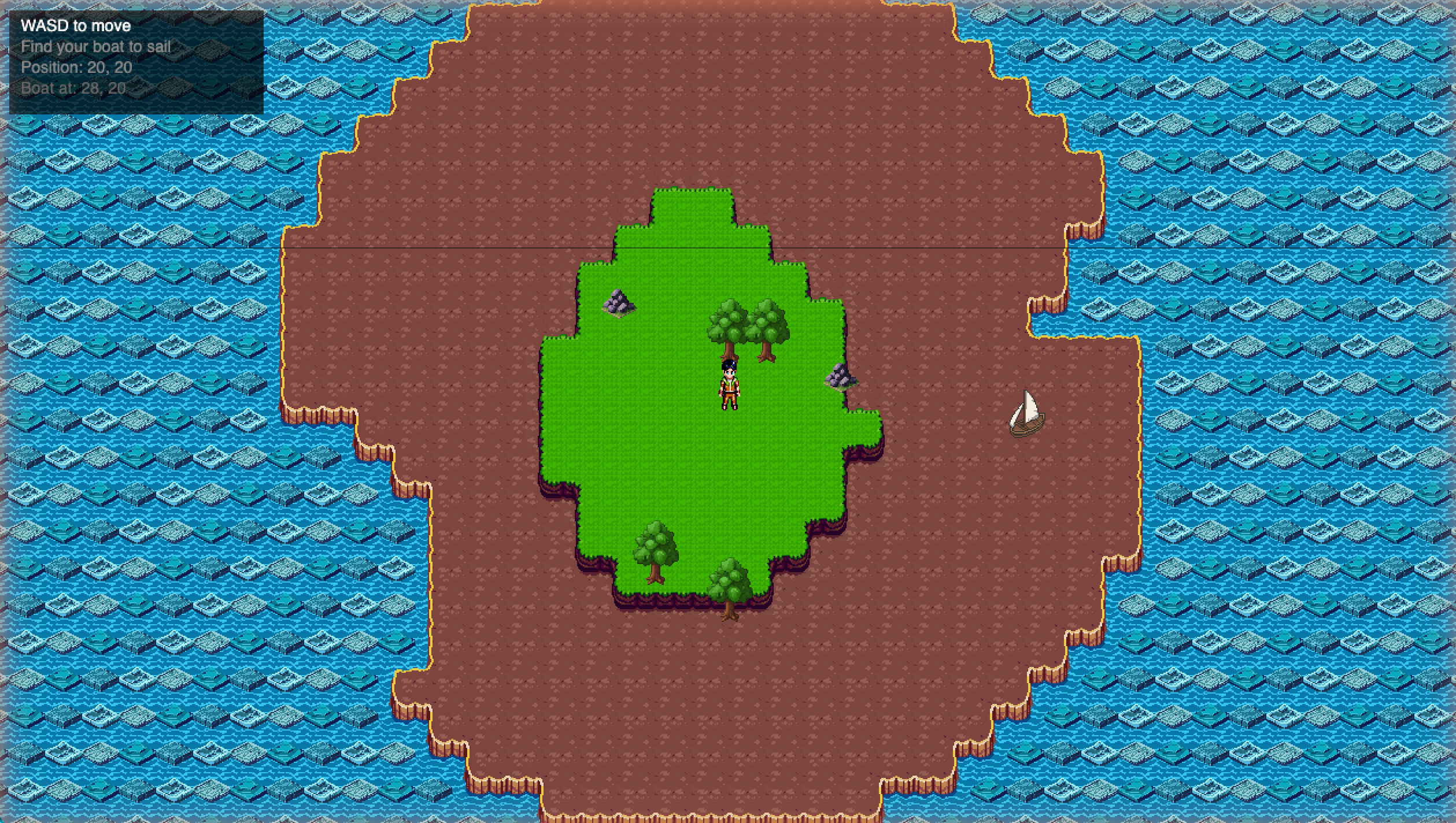
What PixelLab generates
PixelLab has an MCP server, so I used it directly from Claude Code. The main asset types I used:
Wang tilesets - These are 16-tile sets that handle terrain transitions automatically. You describe the two terrain types (like "ocean water" and "dirt cliff") and it generates tiles for every possible corner combination. I generated six tilesets: water-dirt, dirt-grass, grass-stone, water-sand, stone-snow, and grass-forest.
Characters - You describe an appearance and it generates 8-directional sprites. It also generates walking animations as 6-frame sprite sheets for each direction. The character came out at 64x64 pixels.
Map objects - Trees, rocks, a sailboat. These come with transparent backgrounds ready for compositing.
Isometric tiles - I used these for animated water. Generated four water tiles with different seeds to use as animation frames.
The procedural world
The world uses chunk-based generation. Each 16x16 tile chunk gets generated on demand as the camera approaches, then cached. Islands are placed using spatial hashing - divide the world into a grid, and deterministically decide if each cell has an island based on a seeded random function. This means the same coordinates always produce the same terrain, even though the world is infinite.
Terrain elevation uses distance from island centers with quadratic falloff, plus some noise for natural-looking coastlines. The elevation maps to terrain types: water, dirt, grass, stone. Wang tiles handle the transitions automatically based on the four corner values of each cell.
The boat
The boat parks where you leave it. Walk to it and press space to board, sail to another island, press space near land to disembark. The boat stays at that world position until you return. Simple, but it means you have to think about where you park.
What worked well
PixelLab's tilesets are genuinely useful. The Wang tile system means you don't have to manually place transition tiles - you just set terrain values at vertices and the right tile gets selected automatically. The visual consistency across different tilesets is good enough that water-dirt-grass-stone transitions look coherent.
Generating assets through an MCP server from Claude Code made iteration fast. Describe what you want, wait 30 seconds, see if it works, adjust the prompt if needed.
Code
The whole thing is one HTML file with inline JavaScript - about 1100 lines. No build step, no dependencies, just open the file. Source is at github.com/dzoba/island-explorer.