
One of Bremner's magic square families never gets a seventh square
from a human
Nobody has found a 3x3 magic square with seven square entries other than one example from the 90s. Bremner had a family that always gives six squares, and in 2001 he couldn't rule out a seventh. Claude showed it never happens, with the free Magma calculator, and Codex checked the proof and fixed one step.
In 2001 Andrew Bremner wrote down a one-parameter family of 3x3 magic squares in which six of the nine entries are perfect squares for every rational value of the parameter. A seventh square would need one of the three diagonal entries to be a square too. He showed the center entry never is, apart from a trivial case. For the two corners the question comes down to the rational points on a curve of genus 3, and he wrote that the obvious points are "likely" the only ones, "though we are unable to show this." Those are the only ones. So no member of the family has a seventh square, apart from the two trivial parameter values where all nine entries are equal.
Claude did the work under my direction, using the free online Magma calculator, and each run took under 15 seconds. Codex refereed it. It reproduced the algebra, found that one step of the original write-up was explained wrongly, and replaced it with a correct argument. It did not rerun two parts, Magma's Mordell-Weil group and Chabauty computations on a genus 2 curve, and I say more about that below.
The problem
A magic square of squares is a 3x3 grid of distinct perfect squares where every row, column and both diagonals have the same sum. Nobody knows whether one exists. Martin LaBar asked for one in the College Mathematics Journal in 1984 (Problem 270), and Martin Gardner wrote about it in Quantum in 1996 and offered $100 for an example or a proof that none exists. Christian Boyer keeps a list of open magic square problems at multimagie.com. The page was last updated in 2020, and it lists €1,000 and a bottle of champagne for a 3x3 magic square with 7, 8 or 9 distinct square entries, other than the one known example, and €500 for a proof that 8 or 9 is impossible.
The known example has seven squares:
  373²     289²     565²
360721     425²      23²
  205²     527²   222121
Every line sums to 3 x 425² = 541,875. The two entries that aren't squares are 360721 and 222121. Bremner published this square in the first "On squares of squares" paper (Acta Arithmetica 88, 1999).
In the sequel, "On squares of squares II" (Acta Arithmetica 99, 2001, pages 289 to 308), Bremner sorts the ways of choosing six cells out of nine into sixteen configurations, up to symmetry, and shows that each of them has infinitely many magic squares with those six cells square. He gets them as polynomial families in one parameter µ. Then asking for a seventh square means asking for the rational points on a curve y² = f(µ), where f is the polynomial in the seventh cell. These curves usually have high genus, and by Faltings' theorem each one has only finitely many rational points, but saying which points those are is the hard part.
Family (9)
His worked example is configuration II, where the six off-diagonal cells are the squares. The smallest family he writes down has entries of degree 8 in µ, his equation (9). Here it is at µ = 1/2, multiplied through by 2⁸ to clear denominators:
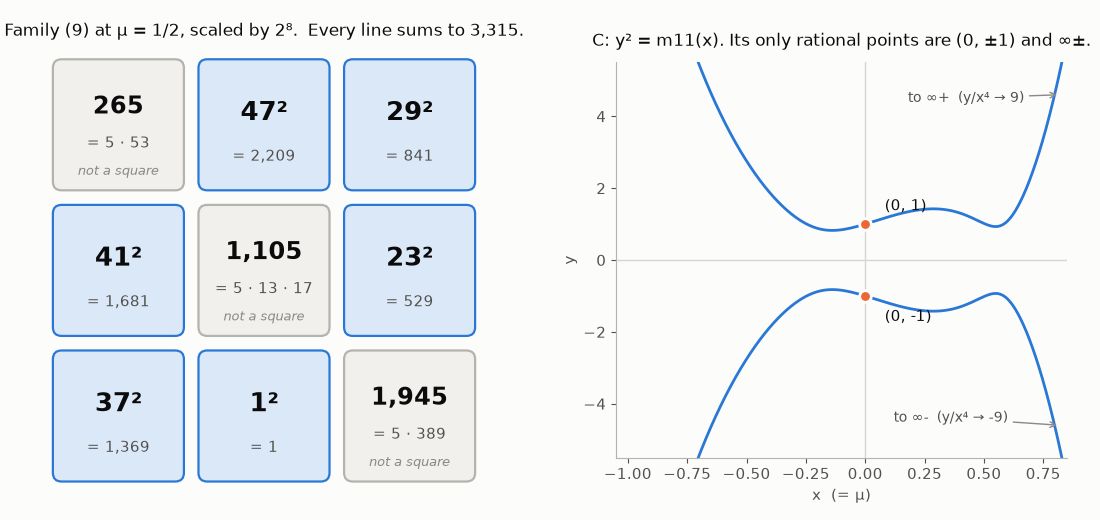
All nine entries are distinct, every line sums to 3,315, and the diagonal entries 265, 1105 and 1945 are not squares. The diagonal entries of the family are:
m11 = 1 + 4µ + 8µ² - 28µ³ - 2µ⁴ - 84µ⁵ + 72µ⁶ + 108µ⁷ + 81µ⁸
m22 = (1 + µ²)(1 + 9µ²)(1 - 2µ² + 9µ⁴)
m33 = m11(-µ)
At µ = 0 every entry is 1 and at µ = ∞ every entry is 81 (after scaling), so those two values give trivial squares with repeated entries. In the remark on page 295 Bremner handles the center: m22 is a square only when an elliptic curve of conductor 48 has a suitable point, and that curve has rank 0, which forces µ = 0. For the corners, m11 is a square exactly when (x, y) is a rational point on
C: y² = 1 + 4x + 8x² - 28x³ - 2x⁴ - 84x⁵ + 72x⁶ + 108x⁷ + 81x⁸
and m33 is the same curve with x replaced by -x. C has genus 3. It has the points (0, 1) and (0, -1), and two points at infinity, ∞+ and ∞-, where y/x⁴ tends to 9 and -9. Bremner found that its Jacobian contains an elliptic curve of conductor 1104 and rank 1, searched for small points, found nothing new, and stopped there.
The right half of the figure is the real graph of C. m11 is positive for every real number (its minimum is about 0.678, near x = -0.14), so the real picture rules nothing out, and the answer has to come from arithmetic.
The proof
C(Q) = {(0, 1), (0, -1), ∞+, ∞-}. The argument is a standard one for curves like this: split the curve into smaller pieces using its symmetries, find a piece whose Jacobian has rank less than its genus, and use Chabauty's method on that piece.
- Magma finds that the automorphism group of C has order 4. Besides the hyperelliptic involution y → -y there is another involution, (x, y) → (1/(3x), -y/(9x⁴)), and the quotients of C by the three involutions have genus 0, 1 and 2. The genus 1 quotient is the elliptic curve
E: y² = x³ - x² - 8x + 48, with conductor 1104 and rank exactly 1, which matches Bremner. The genus 2 quotient isD: y² = x⁶ - 4x⁵ + x⁴ + 2x³ + 14x² - 8. The Jacobian of C splits, up to isogeny, as E times the Jacobian of D. - Magma's
MordellWeilGroupGenus2gives the Mordell-Weil group of the Jacobian of D as Z/4 x Z, with both of its "proved" flags true. So the rank is 1, which is less than the genus, 2. - That is the condition Chabauty's method needs. When the rank is less than the genus, there is a p-adic integral, not identically zero, that vanishes at every rational point. It has finitely many zeros, and Magma's routine combines it with a Mordell-Weil sieve to decide which of them are rational points. Magma's
Chabautyreturns D(Q) = {(2, 4), (2, -4), ∞+, ∞-}. - Every rational point of C maps to a rational point of D, so it is enough to look at what lies over those four. Over (2, ±4), the x-coordinate on C would have to satisfy 3x² - 2x + 1 = 0, which has discriminant -8 and no rational root. Over the two infinite points of D, the points of C are x = 0 and x = ∞. That leaves exactly the four known points.
The three Magma runs took 11.2, 3.5 and 2.7 seconds on the online calculator, Magma V2.29-10. The calculator accepts a script over plain HTTP and returns the output, so Claude could submit them with curl. Magma's Chabauty routine for Jacobians works on genus 2 curves, so the route goes through D.
How it was checked
Step 4 was where Codex found the problem. In the first write-up Claude had taken the fibers from Magma's Pullback function, which listed both points at infinity of C over every one of the four points of D, including the finite points (2, ±4). A map sends each point to one place, so that output can't describe the actual fibers. Claude's notes explained it away as "how the weighted-projective map behaves at infinity". Codex said that explanation was wrong. It wrote the quotient map down explicitly in weighted projective coordinates, as A = 3X² + 2XZ + Z², B = (3X² - Z²)Y, C0 = 2XZ, checked that it has no base points, and worked out where each of the four points of C goes. That gives the argument in step 4. The conclusion is the same, and that step no longer depends on the Pullback printout.
It reproduced these with PARI/GP, in a script that took about 0.02 seconds of CPU:
- the polynomial identity that makes the quotient map C → D a morphism over Q, and the fiber equation 3x² - 2x + 1 with discriminant -8;
- the change of variables between D and the genus 2 model the lab had used in earlier work;
- the map from the genus 1 quotient to E, and E's conductor (1104), torsion (order 2) and rank (1, by PARI's
ellrank); - that pulled-back differentials from E and D have a 3x3 coefficient determinant of -48, which is nonzero, so the Jacobian of C really does split as E times the Jacobian of D;
- all nine polynomials of family (9) and all eight magic-line identities, and that µ = 0 and µ = ∞ give the all-1 and all-81 grids.
It did not rerun Magma's Mordell-Weil group computation for D or its Chabauty computation. For those it checked the Magma handbook: the fourth return value of MordellWeilGroupGenus2 means the group is proved, the run passed no conditional assumptions such as GRH, and with rank 1 the one-argument Chabauty returns all the rational points. So the result relies on Magma's implementations of those two routines, as they ran in our saved outputs.
There is a second, separate certificate for the same four points. The lab also attacked this curve with its own code: 5-adic Chabauty on the genus 2 quotient, which left extra 5-adic zeros in two residue discs, removed in the end by a computation modulo the auxiliary prime 1091. That certificate doesn't use Magma and has its own independent checker report. Codex checked its file hashes and its dependency chain, and read the argument that assembles the parts, but it did not rerun that arithmetic either.
What this doesn't show
This is one curve. Family (9) is the degree 8 member of what Bremner calls a two-dimensional family of magic squares in configuration II (Bremner lists degrees 8, 10, 12, 16, 20 and up), and there are fifteen other configurations. It says nothing about squares with eight or nine square entries, and nothing about seven-square squares outside this family. It answers a question Bremner left open on page 295, and it doesn't touch Boyer's prize.
The Magma scripts, their outputs and Codex's report are in the lab's working directory. They aren't public yet.